The $18,000 Brass-to-Tin Disaster: Why Alibaba Trade Assurance Failed Mike
How a California Amazon FBA seller lost $18,000 to a bait-and-switch supplier on Alibaba, and why Alibaba Trade Assurance only awarded him $350.
The $18,000 Brass-to-Tin Disaster: Why Alibaba Trade Assurance Failed Mike
In March 2025, Mike Henderson, a 34-year-old Amazon FBA brand owner based in Irvine, California, found what looked like the holy grail of bathroom hardware suppliers on Alibaba.
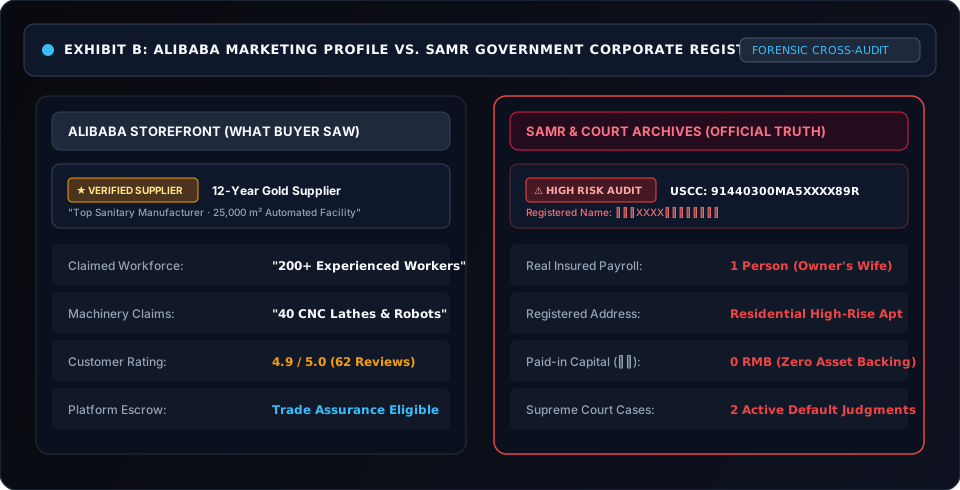
The supplier—Shenzhen JXXXX Sanitation Technology Co., Ltd.—carried an Alibaba Verified Supplier badge, had a 4.9-star rating across 62 reviews, and boasted an opulent 3D digital showroom displaying CNC milling machines and gleaming robotic electroplating arms.
Mike was developing a premium matte-black brass shower fixture for the US market. He ordered a golden sample for $85. When it arrived via DHL three days later, Mike was thrilled:
- It weighed a solid 4.2 pounds.
- The threads were precision-machined.
- It passed his water pressure and salt-spray tests with flying colors.
Confident that he was dealing directly with a legitimate manufacturer, Mike pulled the trigger: he negotiated an order of 1,200 units and wired a 30% deposit of $18,000 via Alibaba Trade Assurance.
Four months later, that decision nearly drove his business into bankruptcy.
1. The Opening Day Nightmare: 1,200 Units of Scrap Metal
When the 40-foot container arrived at the Port of Long Beach and cleared customs into Mike’s 3PL warehouse, his fulfillment manager called him immediately:
“Mike, you need to come down here. These boxes weigh half of what the sample did.”
Mike cut open the first master carton with trembling hands.
The finish looked identical on the surface. But when he tapped the showerhead against the concrete floor, there was no solid metallic chime—only a hollow, tinny clatter.
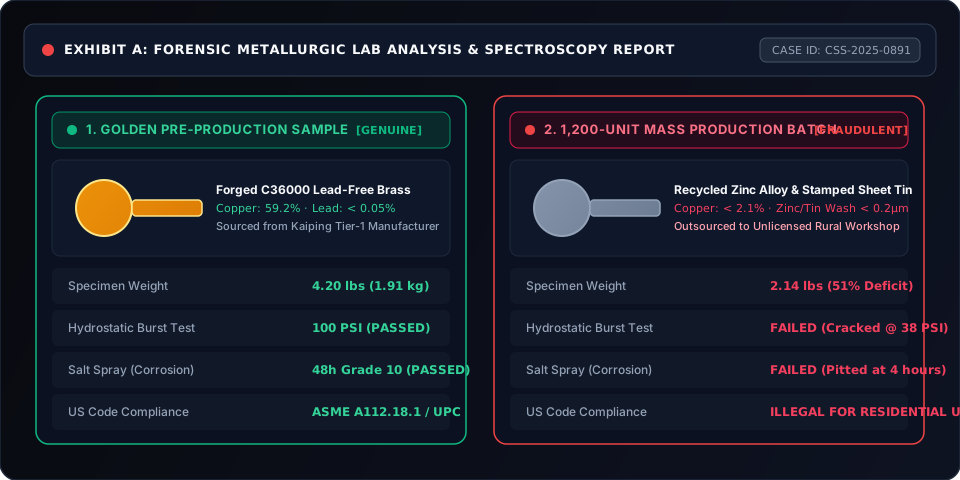
Mike sent three units to a metallurgic lab in Santa Ana:
- The original sample was C36000 lead-free forging brass (copper content > 58%).
- The mass-produced batch was made of recycled zinc alloy and thin stamped sheet tin with an electroplated brass wash less than 0.2 microns thick.
Under US municipal plumbing codes (UPC/ASME A112.18.1), thin zinc fixtures will crack under standard residential water pressure and cause catastrophic indoor pipe bursts. If Mike shipped these to Amazon FBA, a single burst pipe could trigger millions of dollars in property damage lawsuits.
He had 1,200 units of unsellable scrap metal sitting in California.
2. Why Alibaba Trade Assurance Closed the Case on Him
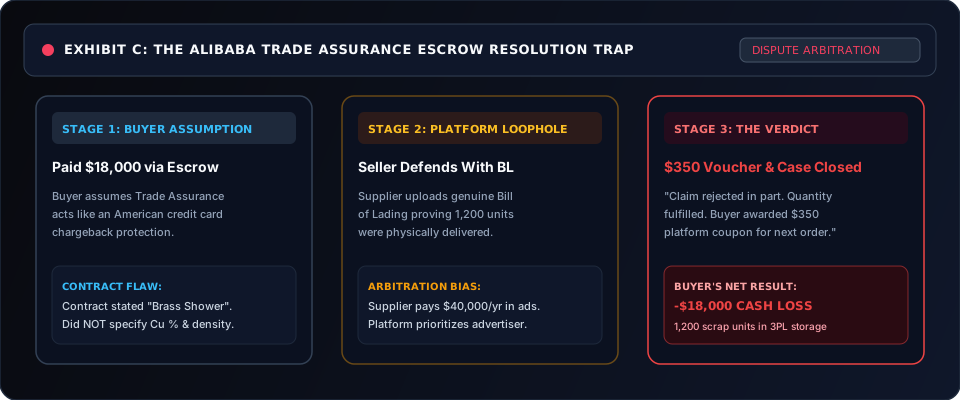
Mike assumed he was 100% safe because he had paid through Alibaba Trade Assurance. He filed an official dispute within 48 hours, uploading lab spectroscopy reports, side-by-side weight measurements, and high-definition photos.
Two weeks later, the Alibaba arbitration representative delivered the verdict:
“Dispute Resolution: Claim rejected in part. Seller has fulfilled the contract by delivering the contracted quantity of goods supported by bill of lading. Specification deviation was not explicitly codified in signed purchase contract under tensile tolerance standards. Seller agrees to issue a $350 platform voucher for future orders.”
Mike was stunned. Why did Trade Assurance fail him so completely?
The 3 Crucial Traps Mike Fell Into:
- Trade Assurance Protects Delivery, Not Hidden Metallurgy: Unless your Alibaba purchase contract contains an airtight, clause-by-clause chemical composition tolerance breakdown (e.g., “minimum 57.5% Cu, zero zinc substitute”), Alibaba arbiters treat material deviations as “commercial grade variations.”
- The “Gold Supplier” Myth: The platform’s algorithm and arbiters inherently favor mega-suppliers who spend $20,000–$50,000 annually in advertising and membership fees. A one-off $18,000 buyer claim is rarely prioritized over an active platform advertiser.
- No Pre-Shipment Inspection (PSI): Mike paid the 70% balance before the container left the factory gates because the supplier threatened to withhold the bill of lading. Once the money is released to the seller, Trade Assurance’s leverage disappears.
3. What China’s Official SAMR Records Actually Showed
Desperate for answers, Mike reached out to our forensic team to investigate Shenzhen JXXXX Sanitation Technology Co., Ltd.
We pulled their official Chinese corporate file from the State Administration for Market Regulation (SAMR) and cross-referenced the Supreme People’s Court database.
In less than 15 minutes, the ugly truth emerged:
The Forensic Findings:
- They Were a 1-Person Apartment Reseller: The company did not own a single lathe, press, or factory worker. They were operating out of a residential high-rise in Bao’an District, Shenzhen.
- The Golden Sample Was Bought from a Real Tier-1 Factory: To win Mike’s deposit, the trader walked into an authentic high-end faucet manufacturer in Kaiping, Guangdong, bought 1 high-grade export unit, and shipped it to Mike as a “custom prototype.”
- The Mass Production Was Outsourced to an Illegal Black Workshop: Once Mike wired the $18,000, the middleman outsourced the order to an unlicensed rural workshop in Jieyang that specializes in cheap zinc substitutes, pocketing a 62% profit margin.
- Prior Lawsuits Detected: In the Chinese Supreme Court civil records, the owner already had two active contract default judgments (买卖合同纠纷) from domestic Zhejiang suppliers whom he had previously defrauded.
Had Mike spent $39 on an independent verification check before transferring his deposit, he would have spotted the zero paid-in capital, the 1-person payroll, and the pending litigation before releasing a single dollar.
4. The 3-Step Defense Blueprint for Every Importer
To protect your Amazon FBA or Shopify business from the same fate, implement these mandatory rules immediately:
Rule 1: Always Demand the Chinese Name & 18-Digit Credit Code
Never rely on an English marketing alias. Legitimate Chinese entities possess an official 18-digit Unified Social Credit Code (统一社会信用代码) starting with 91 or 92.
Rule 2: Inspect Government-Insured Social Security Headcount
Suppliers on Alibaba can rent empty warehouse space for 3 days to shoot drone videos. But they cannot fake government social security records (社保缴纳人数). If a supplier claiming 200 workers has only 2 people on government payroll, they are an unlicensed middleman.
Rule 3: Never Release the Final Balance Without Pre-Shipment Inspection
Always book an independent inspection ($199) or consolidate samples ($59) through an independent third-party team in Guangdong before releasing the final 70% payment.
Need to Verify a Chinese Supplier Before You Pay?
Don’t guess. Let our local legal research team in China cross-reference your supplier’s SAMR registration, real factory payroll, and Supreme Court litigation records.
Senior Supply Chain Risk Specialist · China Supplier Compliance Desk